Among the most significant challenges facing our evolving societies, our attitude toward the homeless is one of the greatest obstacles to the development of urban resilience. We continue to ignore the importance of providing shelter for the most vulnerable. “Not in my back yard” is implicit in our behavior, and too many examples of proactive affordable housing policies are diluted by market-driven approaches.
We reject what we ourselves have created instead of reflecting on the causes that keep producing the same results.
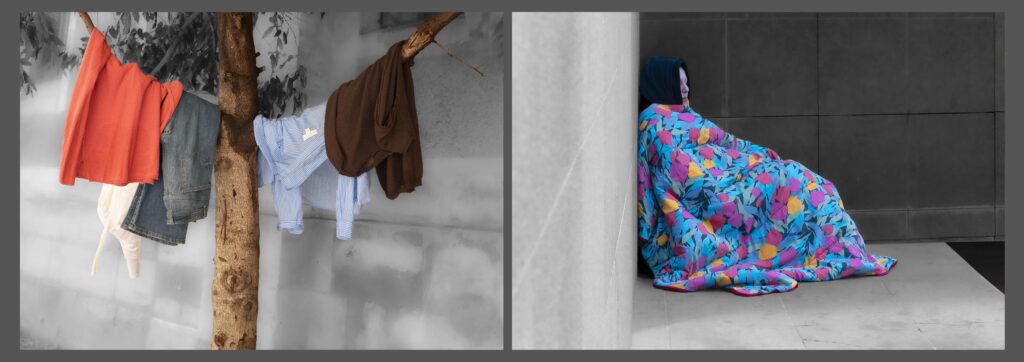
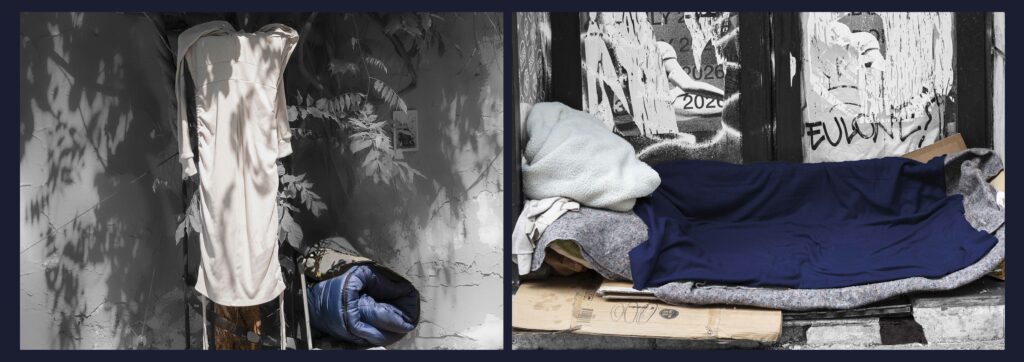
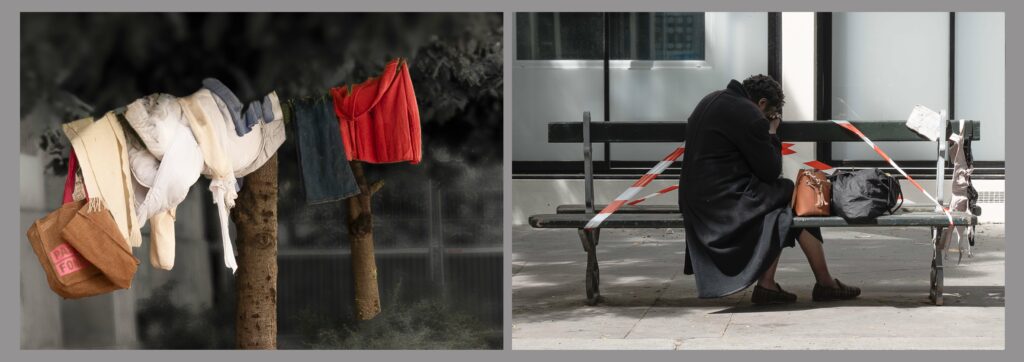
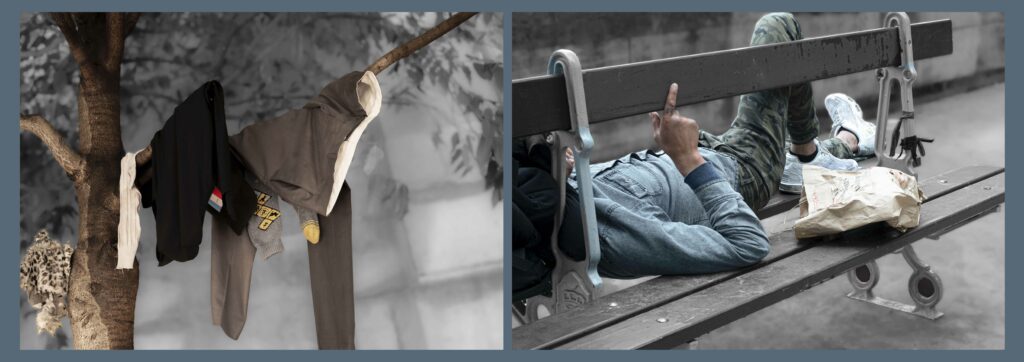
In the “Undesired Fruits” series, photographs of homeless people’s clothes drying on tree branches echo the presence of those street dwellers we pass by, sometimes without even noticing them. Like undesired fruits we refuse to accept without considering the roots that produced them.
Shooting place: Paris, France.
Works sizes (unframed): 84 x 30 cm ( 33 x 12 in), with argentic paper inclusions.
By the greatest of coincidences, while I was working on Undesired Fruits, I happened to be reading Le Livre de Kells, the novel by Sorj Chalandon. I do not know whether it has been translated into English. Sorj Chalandon himself spent a year living on the streets. Few writers have conveyed with such accuracy and emotional truth what it feels like to be homeless.
Here is one of its passages:
“More than the poor you leave behind, it is the pavement itself you must distrust. That public bench that took you in, that subway entrance whose warmth sheltered you through winter, that tree in that little square beneath which you once considered hanging yourself, that railcar left standing at the platform, that kneeler at the back of the chapel, that mooring ring on the quay where you sharpened your knife, that tree which spoke to you one evening. None of them will forgive your betrayal.
(…)
“See you soon,” jokes the prison guard as he escorts the inmate to the gate when his sentence is over. “See you very soon,” smiles the pavement as you try to leave it behind. To escape the streets was to live in fear of returning to them. A fear that pierced every moment, as though the deserted landing outside our door had been waiting for us all along—and would go on waiting for the rest of our lives—with its “Welcome” doormat that seemed meant for no one but us.
To be without a roof over one’s head is a haunting, an affliction. I knew it from the very first day.”